

Anderson: Name and Tartans
The Anderson Name and Origins of Clan Anderson
Anderson, and its Gaelic equivalent, MacAndrew, have complex origins. The family is a member of the Ross clan, which, in the mists of time past, took as their clan name Aindrea (Andrew). It’s quite probable, given the closeness of the northern county of Ross-shire to the north coast, that the name has Danish (or Viking!) origins.
The name, Gillander / Gillanders could be derived from the Gaelic Gilleandrais, which means servant of Andrew. Alternatively, however, Gillanders is also of Norse extraction and can be found in common usage today in Scandinavia as Silander and Andersen.
The name, Anderson, simply means Andrew’s son or son of Andrew. This form of name, where ‘son’ is added to the father’s namei is called a patronymic surname. In Scotland, the Gaelic patronymic is formed by adding mac to the beginning of the father’s name. Hence Anderson is also MacAndrew.
Anderson, as well as son of Andrew, is also taken to mean ‘servant of St Andrew’. St Andrew is the patron saint of Scotland. In Gaelic, the form is Gilleandrais – St Andrew’s gillie (gillie is Gaelic for servant). And so, son of Gilleandrais is MacGillandrish.
Clan and Associations
The Anderson family is most often linked to Clan Ross. The old Gaelic name used by Clan Ross is Siol Aindrea or Clan Aindrea, meaning the race of Andrew.
Oddly enough – and further complicating matters – there is evidence of a MacAndrew link to that great federation of clans, Clan Chattan. A Donald MacGillandrish is referenced in an old text written by Lachlan Mackintosh in 1679, called the Kinrara Manuscript. The manuscript (itself sourced from three older manuscripts) records a Donald MacGillandrish as coming from Muidart (that’s Moidart on the west coast) with Mora Macdonald, Lady Mackintosh, to Connage of Petty. Connage is a village a few miles north of Inverness, in the district of Badenoch. The link from Mackintosh to Clan Chattan is that Mackintosh is often regarded as the ‘stem-family’ of Clan Chattan.
But it is the Ross clan that Anderson and MacAndrew are most often associated, or considered to be a part of the clan.
Crest Badge
 The wearing of the clan’s crest on a badge is a custom that is recognised in Scots heraldic law. Clan chiefs would give their followers a metal plate of their crest to wear as a token of their connection to the clan and the chief. The plate would be fixed to the person’s clothing by a strap and buckle, and when not in use the strap and buckle would be wound around the plate.
Nowadays, instead of wearing a plate with belt, people wear the crest on a badge. The clan crest badge of Anderson takes the form of the oak tree crest in the middle of the badge with a metal representation of belt and strap encircling the crest. The clan motto, Stand Sure, is engraved onto the belt.
The badge shows that the wearer is a kinsman or a follower of the clan chief. Only the chief of the clan and his heirs are entitled to wear the crest without the belt.
Famous Andersons & MacAndrews
The Tale of Little John MacAndrew
One of the most noted MacAndrews in the family history was a bowman, Iain beag MacAindra who lived in the seventeenth century in the lands of Kelravock in Badenoch. (Iain beag MacAindra, by the way, translates to little John MacAndrew).
In 1670, a raiding party of MacDonnels stole 12 head of cattle from the farm at Kelravock. It was a highland custom at the time to steal or ‘lift’ cattle before a marriage, and the raiding party’s leader, McDonnel of Achluachrach, was indeed engaged to be married.
The tenants of the farm, one of whom was Iain beag MacAindra, who looked after the cattle set off in hot pursuit. They found the MacDonnels sheltering in a bothy or hut and that they had feasted on one of the stolen cows before settling down for the night. As the pursuers crept quietly up to the bothy door, MacAindra took the slaughtered cow’s hide and placed it, hairy side down, at the the door and shot an arrow in through the window.
At once, Achluachrach rushed from the door and slipped on the slippery hide and was shot by a single arrow from MacAindra. Once the hut door was open, a shower of arrows from MacAindra and his kinsmen killed all the MacDonnels. During the fight, the leader of the pursuers, William Mackintosh of Kellachie, shouted, “God and victory be with you, Iain MacAindra!”. Little John, aghast at this revealing of his name, fearful as he was of repercussions from the powerful MacDonnels, shouted back, “A thousand curses on your tongue, squint-eyed John of Kellachie”.
MacAindra was proved right. Although none of the MacDonnels in the bothy survived, the sentry did and on his return home told the clan that it was MacAindra who had killed Achluachrach, for which the MacDonnels vowed bloody revenge. Although he escaped being killed, Little John MacAindra spent the rest of his days hiding from the MacDonnels, still cursing the loose tongue of ‘squint-eyed’ John Mackintosh of Kellachie.
James Anderson of Sterheuch
Concentrated in the county of Aberdeenshire, the Anderson name is well known in the area and came to prominence here in the 16th century. One of the earliest references was to a James Anderson of Sterheuch.
In 1527, he was appointed by King James V to the position of Carrick Pursuivant of Arms. At the time, it would have been inconceivable to have held such a position at the Court of the Lord Lyon without your own family arms. And it seems that arms were indeed granted to an Anderson of that Ilk but, interestingly, this family has never been identified as no place exists called Anderson!
‘Of that Ilk’ is used by the Scottish nobility as a kind of shorthand to avoid repeating the clan name which matches the fief or place where the clan originated. For example, the family name of Moncreiffe of Moncrieffe is traditionally shortened to Moncrieffe of that Ilk.
In Anderson’s case, it seems likely that the Lord Lyon simply used the Crown’s armorial prerogative to receive and number Anderson as the representative of the name in order to confer the arms.
Alexander and David Anderson
Alexander Anderson was a mathematician and Professor of Mathematics in Paris. He published his six works on Geometry and Algebra there, between 1612 and 1619. His cousin David Anderson was an architect and a merchant who had an interesting claim to fame. He’s famous as ‘Davie-Do-a’-Things’ (ie David who does everything) and the man who figured out how to remove a massive rock that had obstructed the entrance to Aberdeen harbour! You can see his portrait at the National Gallery in Edinburgh. He left an endowment after he died to found a school for ten poor orphans in Aberdeen. David’s daughter was the mother of the mathematician and astronomer, James Gregorie.
Adam Anderson
Adam Anderson was appointed one of the trustees for establishing the colony of Georgia in 1732. Many Scotsmen of course emigrated to the colonies (as the US was called before the War of Independence) and, in Georgia helped to build and hold the fort there against Spanish attack. The famous civil war prison of Andersonville was named after Adam. But it is a scientific study of commerce that Adam Anderson is to be remembered. His Historical and Chronological Deduction of the Origin of Commerce was published in 1765, shortly before his death.
James Anderson
James Anderson was a noted author and historical of his day. Living in18th century Scotland, he was a vociferous opponent of the 1707 Treaty of Union between Scotland and England. In 1705, trying to sway opinion, he wrote his famous work, An historic Essay Showing the Crown and Kingdom of Scotland is Imperial and Independent.
The Candacraig Andersons and other Andersons
The descendants of Patrick Anderson’s family held the land of Candacraig in Strathdon for 10 generations. Anderson bought the land in 1620 and the family held it until they emigrated to Canada in the 19th century.
After the restoration of the monarchy following Charles II’s coronation in 1651 at Scone (actually the last coronation at Scotland’s ancient coronation site), John Anderson of Dowhill was appointed Lord Provost of Glasgow in 1665 and again in 1667.
An Alexander Anderson established the North of Scotland bank in 1836. In the 1840s he overcame great opposition to promote the arrival of the railway to Aberdeen. He was elected Lord Provost of Aberdeen and in 1863 was knighted by Queen Victoria’s husband, Prince Albert.

In the west of Scotland, William Anderson of Stobcross gave the family name to the district of Anderston (Andrew’s town) in Glasgow.
In the 20th century, John Anderson of Edinburgh achieved high political office in Winston Churchill’s wartime cabinet, serving as home secretary, Lord President of the Council and Chancellor of the Exchequer. Interestingly, he was the last person to achieve high political office in the UK as an independent MP, ie he was not a member of a political party.
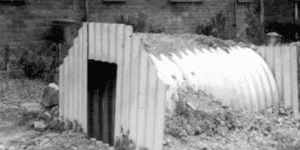
He is particularly remembered by the dwindling band of people in the UK who lived through World War II as the man behind the creation of the Anderson shelter, the little shelter that people erected in their gardens to take cover from falling enemy bombs.
Anderson Tartans
The origin of the Anderson tartan is unknown but the type of pattern suggests that it had its base in one of the ‘fancy’ types of design that were becoming popular in the few years immediately preceding the visit of King George IV to Scotland in 1822. In these times, when the tartan revival was beginning to gather some momentum, there was a ready sale of ‘fancy’ patterns when they could be worn for reasons of preference. Several of these tartans passed to posterity as clan tartans.
The elaborate pattern gives the impression of being made up of elements from older designs and slight variations on the sett (a pattern is typically called a ‘sett’ by weavers) can be apparent when tartans are compared.
There are three Anderson tartans currently available: Modern, Ancient and Weathered. The modern and the ancient tartans are available in accessories and the Anderson clan crest is available in our clan jewellery. The weathered cloth is currently available only as a heavy cloth, suitable for the heavyweight kilt.
To choose your Anderson tartan accessory or Anderson tartan garment, please visit the Anderson tartans accessory page.
Anderson Modern

Anderson Ancient
